Outdoor kitchens can range from a built-in grill and counter to complete cooking and entertaining spaces with several gas-powered appliances. Before cabinetry, countertops, hardscape, and other permanent features are installed, homeowners should identify the equipment they intend to use and determine where those appliances will be positioned.
Those decisions matter because an outdoor kitchen does not operate independently from the rest of the home’s gas system. Outdoor cooking equipment adds to the demand already created by water heaters, furnaces, ranges, dryers, fireplaces, and other gas appliances, so the existing system and proposed additions need to be considered together.
Distance and routing can also influence the project. An outdoor kitchen located against the house presents different conditions from a detached cooking area across a patio or yard. Landscaping, concrete, pavers, structures, irrigation, electrical service, and other site conditions can affect how utilities reach the outdoor kitchen, making early coordination especially valuable.
Planning these details establishes a stronger foundation for the project without replacing the professional evaluation required for the actual piping work. When the project reaches that stage, our Gas Line Installation service covers the broader sizing, routing, testing, permitting, and code-compliance considerations involved in professionally installed residential gas systems.
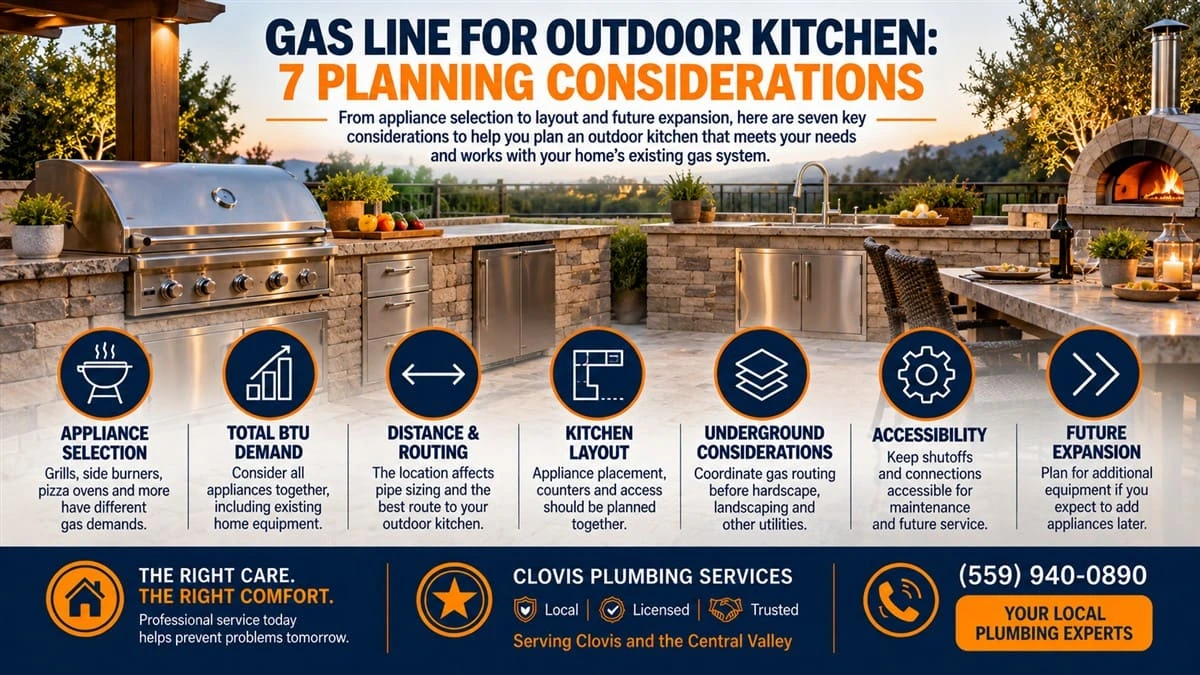
Table of Contents
1. Identify the Gas Appliances in Your Outdoor Kitchen
Gas planning should begin with the equipment rather than with assumptions about the piping. A basic outdoor kitchen may contain only a built-in grill, while a larger design might include a grill, side burner, pizza oven, griddle, or other permanently installed gas appliances. Each piece of equipment has its own fuel requirements, and those requirements become part of the overall plan.
Manufacturer specifications are particularly important at this stage because they identify the fuel type and rated input for individual appliances. Gathering this information before the outdoor kitchen is built provides a much clearer picture of what the completed space will require.
Homeowners should also distinguish between equipment included in the current project and appliances they are reasonably likely to add later. Planning for known possibilities does not guarantee that future equipment can be connected without additional evaluation, but it can prevent the initial layout from unnecessarily limiting future options.
If the surrounding patio design also includes a permanent fire feature, our guide to planning a gas line for a fire pit explains considerations specific to that type of outdoor gas equipment.
2. Consider the Combined BTU Demand
The requirements of individual appliances are important, but the total demand placed on the gas system matters as well. Multiple outdoor appliances may operate at the same time while indoor equipment continues using gas elsewhere in the home.
For example, a grill and side burner may be operating while a water heater, furnace, clothes dryer, or other appliance is also running. The outdoor kitchen therefore cannot be evaluated solely by looking at the appliance with the highest rating or by assuming that an existing connection has enough capacity for additional equipment.
This becomes particularly important in homes with high-demand appliances. Tankless water heaters can represent a substantial gas load, which is one reason the existing system should be considered before additional equipment is planned. Our article about a gas line for a tankless water heater discusses the fuel-demand considerations associated with that equipment.
3. Account for the Distance to the Outdoor Kitchen
The location of the outdoor kitchen can affect how its gas requirements are evaluated. Some cooking areas are constructed immediately outside the home, while others are incorporated into detached patios, pool areas, or larger backyard entertainment spaces.
As distance increases, pipe sizing and routing become increasingly important considerations. A longer run must still support the required appliance demand, and the available route may need to work around existing structures, landscaping, hardscape, utilities, and other property features.
This is why the location of an outdoor kitchen should not be chosen solely according to where the grill or countertop looks best. Coordinating the kitchen layout with existing utilities before construction begins can prevent unnecessary complications once permanent surfaces and structures are in place.
4. Coordinate the Gas Supply With the Kitchen Layout
An outdoor kitchen combines appliances, cabinetry, countertops, utility connections, and service access within a relatively compact area. These components need to work together rather than being planned independently.
The positions of grills, burners, ovens, and other gas equipment can influence where connections and shutoff controls need to be located. At the same time, those components should remain reasonably accessible instead of being obstructed by permanent cabinetry or other finished construction.
Custom islands deserve particular attention because utilities may need to reach equipment located away from the house. Moving an appliance several feet on a drawing may appear insignificant, but the change can affect utility routing and how the gas supply interacts with electrical, water, drainage, or structural components.
Finalizing appliance locations early gives the various trades involved in an outdoor kitchen project a common layout around which to coordinate their work.
5. Plan Underground Routing Before Hardscape Is Finished
Outdoor kitchens located away from the house may require gas piping to cross portions of the property before reaching the appliances. Existing and planned concrete, pavers, landscaping, irrigation, drainage, electrical lines, structures, and other improvements can all influence the available route.
Project sequencing becomes especially important when an outdoor kitchen is part of a larger backyard renovation. Identifying utility requirements before new hardscape and finished surfaces are installed can reduce conflicts and provide more flexibility when determining an appropriate route.
Similar considerations arise with other gas-powered equipment located away from the house. Pool and spa equipment, for example, can combine long routing distances with substantial fuel demand. Our guide to gas lines for pool heaters and spas explains the planning considerations associated with that application.
6. Keep Shutoffs and Connections Accessible
An outdoor kitchen may be designed as a permanent improvement, but its appliances will not remain untouched forever. Grills and other equipment eventually require maintenance, repair, cleaning, or replacement, making reasonable access to gas controls and connections an important part of the original design.
Cabinetry and decorative finishes should therefore be planned with serviceability in mind. A visually clean installation does not require hiding essential components where they become difficult to inspect or reach when the equipment needs attention.
Future appliance replacement is another reason to consider accessibility. A replacement grill or cooking appliance may have different dimensions or connection requirements from the original equipment. Providing practical access around the original installation can make those future changes easier to evaluate without unnecessarily disturbing surrounding finishes.
7. Consider Future Outdoor Kitchen Expansion
Outdoor kitchens often develop in stages. A homeowner may begin with a built-in grill and later consider adding a side burner, pizza oven, griddle, or another gas-powered feature as the space becomes more heavily used.
Known expansion plans are worth discussing during the original design because additional equipment changes the total gas demand. This does not mean an oversized or unused connection should automatically be installed for hypothetical future appliances. Instead, the objective is to avoid obvious design decisions that make a reasonably anticipated expansion unnecessarily difficult.
Any future appliance addition should still be evaluated when the equipment is selected. Its fuel demand, location, manufacturer requirements, and the condition and capacity of the gas system at that time will determine what changes, if any, are appropriate.
If an evaluation identifies a problem with existing gas piping rather than a need for a new appliance supply, our Gas Line Repair service addresses existing gas-line problems that require professional diagnosis and repair.
Natural Gas and Portable Propane Serve Different Needs
A permanently supplied outdoor kitchen and one using portable propane cylinders offer different advantages. Portable cylinders provide flexibility for appliances designed for that fuel source, but they need to be monitored and periodically refilled or exchanged. A permanent natural-gas supply eliminates that routine and may be more convenient for homeowners who use their outdoor kitchens frequently.
The intended fuel source should be established before appliances are purchased. Natural gas and propane equipment can have different operating requirements, so homeowners should verify the manufacturer’s specifications rather than assuming that an appliance configured for one fuel can simply be connected to the other.
This distinction is particularly important when an outdoor kitchen design is being developed around specific built-in equipment. Choosing the appliances and intended fuel source early gives the rest of the project a defined set of requirements instead of leaving important utility decisions until construction is underway.
Planning an Outdoor Kitchen Gas Supply in Clovis, CA
Outdoor kitchens in Clovis are often designed as permanent extensions of the home’s living and entertaining space. When a project combines built-in appliances, cabinetry, countertops, hardscape, electrical service, water, drainage, and gas, coordinating those components before construction can make the finished space easier to build and maintain.
Homeowners can prepare for that planning process by identifying the gas appliances they want, collecting the manufacturer specifications, establishing likely appliance locations, and considering future additions. Those details provide useful information when the home’s existing gas system and proposed outdoor equipment are professionally evaluated.
The goal is not simply to get gas from the house to the outdoor kitchen. Good planning considers how the appliances, overall gas demand, route, kitchen layout, accessibility, and surrounding improvements fit together so the gas portion of the project complements the outdoor kitchen rather than becoming an afterthought.
To see recent work completed by Clovis Plumbing Services and feedback from local customers, visit our Google Business Profile.
FAQs: Gas Line for Outdoor Kitchen
Can an existing gas line supply an outdoor kitchen?
Possibly. Whether an existing gas system can support an outdoor kitchen depends on factors such as available capacity, existing appliance demand, pipe sizing, distance, and the BTU requirements of the new equipment. The system should be evaluated rather than assuming an existing line can accept the additional load.
Does every outdoor kitchen need a dedicated gas line?
Not necessarily. The appropriate configuration depends on the home’s existing gas system, the number and demand of the outdoor appliances, the distance involved, and other project conditions. A dedicated run may be appropriate in some designs, but it should not be treated as a universal requirement.
When should I plan the gas line for an outdoor kitchen?
Gas requirements should be considered while the outdoor kitchen layout is still being designed. Planning before cabinetry, countertops, concrete, pavers, or other finished surfaces are completed makes it easier to coordinate appliance locations and utility routing.
Can one gas supply serve multiple outdoor kitchen appliances?
A properly designed system may supply multiple appliances, but the combined demand of the equipment must be considered along with the rest of the home’s gas load. Grill, burner, oven, and other appliance specifications should be identified before the gas requirements are evaluated.
Can I add another gas appliance to my outdoor kitchen later?
Additional equipment may be possible, but the existing gas system should be reassessed before a new appliance is connected. The added BTU demand, available capacity, piping configuration, appliance location, and manufacturer requirements can determine whether changes are necessary.