Garbage disposals operate in an environment that naturally creates wear. Water, food residue, repeated operating cycles, vibration, and mechanical loads are part of normal use, which means every disposal gradually changes as its components accumulate years of service.
Homeowners often want a specific number of years they can expect from a disposal, and the existing article identifies approximately 10 to 12 years as a common service-life range. That number is more useful as a general reference than as a replacement deadline because two disposals of the same age can have substantially different operating histories and physical conditions.
A disposal that has operated reliably without recurring problems presents a different situation from a similarly aged unit that has developed leaks, repeated jams, unusual operation, or other signs of deterioration. Evaluating garbage disposal lifespan therefore requires looking beyond the installation date and considering how the appliance has actually aged.
When an aging unit ultimately needs replacement, the discussion shifts from lifespan to installation compatibility and the conditions beneath the kitchen sink. Our garbage disposal installation service covers those installation-specific considerations separately so this article can remain focused on longevity.
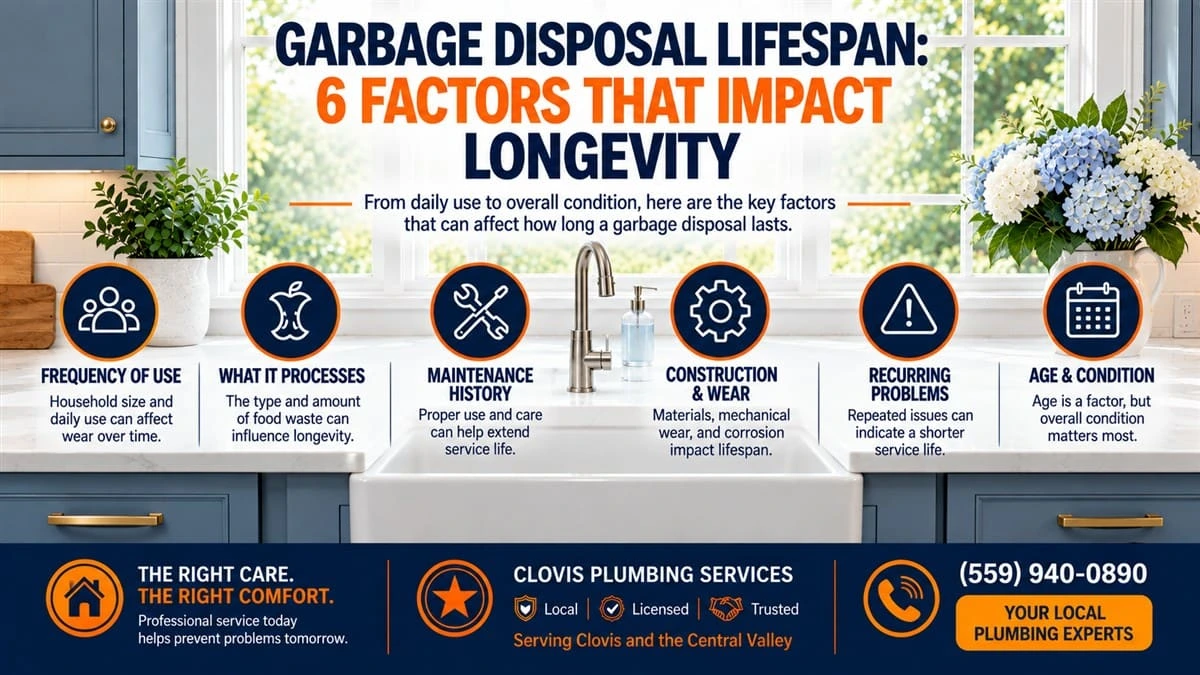
Table of Contents
1. Frequency of Use and Household Demand Affect Lifespan
A garbage disposal serving a kitchen where several meals are prepared each day may accumulate substantially more operating cycles than one used only occasionally. Two units installed during the same year can therefore experience very different amounts of mechanical use.
Household size can contribute to that difference because more frequent food preparation and cleanup generally create more opportunities for disposal use. Frequency alone does not determine exactly when a disposal will fail, but it provides important context when evaluating an older appliance.
This is why chronological age and operating age are not necessarily equivalent. The number of years since installation provides a convenient benchmark, while frequency of use helps explain why some disposals remain dependable longer than others.
2. What the Disposal Routinely Processes Can Influence Longevity
The type and amount of material routinely placed into a disposal can influence the mechanical demands placed on its components. A unit primarily processing small amounts of appropriate food residue can accumulate a different wear history from one frequently subjected to difficult material or excessive loads.
No particular food item can be translated into a specific number of years lost from a disposal’s lifespan. The more useful principle is that repeated unnecessary strain can contribute to mechanical wear and operating problems over time.
Homeowners looking for specific guidance about appropriate use, cleaning, and ongoing care can review our garbage disposal maintenance guide. Those instructions belong on the maintenance article rather than turning this lifespan page into another disposal-care guide.
3. Maintenance and Usage History Matter Over Time
Maintenance does not make a garbage disposal permanent, but the conditions under which the appliance has operated throughout its life can influence its long-term condition. Appropriate use and routine care can reduce some avoidable operating problems, while repeated jams, excessive loading, and neglected problems can create a different history of wear.
This becomes particularly relevant when evaluating a disposal whose previous use is known. A homeowner who has owned the unit since installation may have a reasonably good understanding of how it has been operated and whether recurring problems have developed over time.
Maintenance history should therefore be viewed as one piece of the lifespan assessment rather than a guarantee. Even a carefully used disposal experiences normal mechanical aging, while poor treatment does not allow anyone to predict an exact failure date.
4. Construction, Mechanical Wear, and Corrosion Affect Service Life
Garbage disposals contain mechanical components operating in a consistently wet environment. Materials and construction vary among models, while normal operation gradually subjects internal components to mechanical wear and continued exposure to moisture.
Corrosion and wear do not progress identically in every unit. Construction, operating frequency, usage conditions, water exposure, and the condition of individual components can all contribute to how a disposal ages.
For this reason, purchase price alone should not be treated as a prediction of lifespan. Homeowners comparing the financial considerations involved in purchasing or replacing a disposal can review our garbage disposal cost guide, while this article remains focused on the factors that influence longevity.
5. Recurring Mechanical Problems Can Change the Lifespan Decision
An isolated malfunction does not necessarily mean a garbage disposal has reached the end of its useful life. Individual problems can sometimes occur while the remainder of the appliance is still in reasonable condition.
The calculation changes when an older disposal develops recurring problems or requires repeated attention. Age, physical condition, repair history, and the nature of the current problem can then be considered together rather than treating every malfunction as an unrelated event.
A disposal that hums without operating normally is a good example of why symptoms and lifespan should remain separate subjects. Humming does not by itself establish that the appliance needs replacement, so homeowners experiencing that particular condition can use our garbage disposal humming guide for symptom-specific information.
6. Age and Overall Condition Should Be Considered Together
Age becomes most meaningful when combined with the actual condition of the disposal. An older unit that continues operating normally, remains free of significant leakage, and has not developed recurring problems presents a different replacement decision from a similarly aged disposal showing multiple signs of deterioration.
The reverse is also important. A relatively young disposal should not automatically be considered worth keeping simply because it has not reached an assumed lifespan. Significant physical deterioration or repeated mechanical problems can make condition more important than chronological age.
The practical purpose of understanding garbage disposal lifespan is therefore not to identify a mandatory replacement year. It is to provide a framework for evaluating age alongside usage history, mechanical condition, deterioration, and reliability.
How Long Does a Garbage Disposal Typically Last?
The existing version of this article used approximately 10 to 12 years as a typical service-life estimate. That range can provide homeowners with a useful reference point, but it should not be interpreted as an expiration date.
Some disposals can remain serviceable beyond a generalized estimate, while others develop significant problems earlier. Differences in household use, maintenance history, construction, operating conditions, and mechanical wear help explain why there is no single lifespan applicable to every disposal.
An older unit that continues performing reliably does not necessarily need replacement because it has reached a particular age. Likewise, a younger disposal experiencing significant problems should be evaluated based on its actual condition rather than its installation date alone.
When Does an Aging Garbage Disposal Become a Repair-or-Replace Decision?
Repair and replacement become more meaningful considerations when age is accompanied by an actual operating problem. At that point, homeowners can consider the nature of the failure, overall condition of the disposal, repair history, and age together.
Repeated repairs can change that calculation because continuing to invest in an aging appliance may eventually become less practical. A single repairable problem, however, does not automatically establish that a disposal has exhausted its useful life.
When the immediate question concerns a malfunctioning existing unit rather than general lifespan, our garbage disposal repair service addresses professional repair separately. This keeps repair intent on the service page instead of expanding this article into a troubleshooting guide.
Evaluating Garbage Disposal Lifespan in Clovis Homes
For Clovis homeowners, evaluating an aging disposal is best approached by considering several factors together. Approximate age provides context, but frequency of use, maintenance and usage history, recurring problems, physical deterioration, leakage, and overall operating condition provide a more complete picture.
That distinction also prevents premature replacement based solely on a generalized lifespan estimate. A disposal that continues performing normally may remain useful beyond the average range, while another unit can justify earlier repair or replacement because its actual condition has deteriorated.
Homeowners can view customer feedback and examples of our local plumbing work on the Clovis Plumbing Services Google Business Profile.
FAQs: Garbage Disposal Lifespan
How long does a garbage disposal typically last?
A garbage disposal may commonly provide around 10 to 12 years of service, but actual lifespan varies. Frequency of use, household demands, maintenance and usage history, construction, mechanical wear, corrosion, and overall condition can all influence how long a unit remains serviceable.
Should I replace a garbage disposal after 10 years?
Not solely because of age. A disposal that continues operating normally may remain serviceable beyond 10 years, while an aging unit with recurring problems or significant deterioration may justify replacement sooner. Age is most useful when considered together with the actual condition of the appliance.
Can maintenance affect garbage disposal lifespan?
Yes. Appropriate use and routine care can reduce some avoidable strain and operating problems, but maintenance cannot prevent normal mechanical wear indefinitely. Maintenance and usage history should be considered alongside age, frequency of use, construction, and overall condition.
Does a humming garbage disposal mean it has reached the end of its lifespan?
Not necessarily. Humming is a symptom rather than proof that a disposal has reached the end of its useful life. The cause of the problem, age of the unit, overall condition, and repairability should be considered before deciding whether replacement is appropriate.
Is an older garbage disposal worth repairing?
It can be. The decision depends on the nature of the problem, age and overall condition of the disposal, repair history, and whether problems have become recurring. An isolated repairable problem does not automatically mean an older disposal needs replacement.