A water heater can appear completely reliable when household demand is modest. One shower followed by a long break, an occasional dishwasher cycle, or laundry performed later in the day gives a storage water heater time to recover between uses. The same equipment may behave very differently when several hot-water demands occur close together.
That difference does not automatically mean the water heater has failed. High-demand periods place more pressure on available storage capacity and recovery, which can expose limitations that are difficult to notice during ordinary use. A household may first recognize the pattern during holiday visits, busy mornings, back-to-back showers, or periods when laundry and dishwashing overlap with bathing.
The timing of the problem provides useful information. A shortage that occurs only after several consecutive uses points toward a different set of possibilities than hot water that changes temperature during the first shower of the day. If temperature changes are occurring even under normal demand, our guide to why hot water feels inconsistent suddenly explains several other patterns worth considering.
The goal is therefore not simply to ask whether the water heater “works.” A better question is whether it can still provide the amount of hot water the household expects when demand reaches its normal peak.
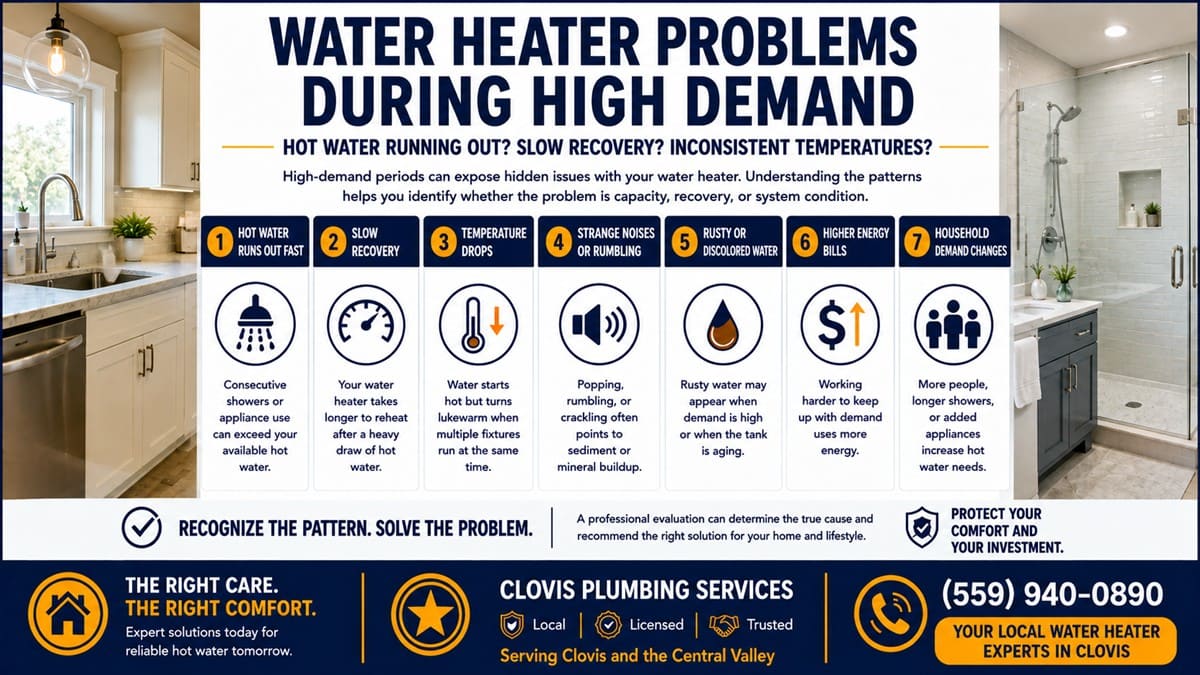
Table of Contents
Why Water Heater Problems During High Demand Become More Noticeable
High demand compresses several hot-water uses into a shorter period. With a storage water heater, hot water leaving the tank is replaced by incoming cold water, and the heating system must begin recovering that lost capacity. When withdrawal happens faster than the heater can replace usable hot water, the available supply gradually declines.
The result may be a shower that starts normally and becomes lukewarm, noticeably longer recovery between users, or a need to postpone appliances until everyone has finished bathing. Those symptoms become especially useful when they occur repeatedly under similar conditions because the pattern can help distinguish an occasional unusually heavy day from an ongoing mismatch between demand and system performance.
1. Hot Water Runs Out During Back-to-Back Showers
One of the clearest high-demand patterns is adequate hot water for the first use followed by progressively shorter hot-water availability for the next person. A storage water heater has a finite amount of heated water available, and consecutive showers can draw from that supply faster than the heater can recover.
This does not necessarily identify a defective component. The tank may simply be reaching its practical capacity under the household’s current usage pattern. However, if the same routine was previously handled without difficulty and now produces shortages, declining performance deserves closer attention because something about the system’s usable capacity or recovery may have changed.
2. Recovery Takes Longer Than It Used To
Running out of stored hot water is only part of the experience. How quickly the system becomes ready for additional use can be equally important. Two water heaters with similar storage capacity can feel very different in a busy household if one restores usable hot water more quickly than the other.
A homeowner may notice this as an increasingly long wait between showers or as a need to delay laundry and dishwashing after bathing. When those workarounds become part of the normal household routine, it is useful to compare the equipment’s performance with the way the home actually uses hot water. Our guide to whether a water heater still fits your household’s daily use looks more closely at that relationship.
3. Multiple Fixtures Create a Noticeable Temperature Drop
Sometimes the problem appears only when two or more hot-water demands overlap. A shower may remain comfortable until another shower starts, a washing machine fills, or another fixture begins drawing hot water. The household may interpret this as random temperature instability even though the pattern is tied directly to simultaneous demand.
Observing which fixtures are operating when the change occurs can therefore be more informative than simply reporting that the water “gets cold.” If performance remains stable when fixtures are used separately but changes consistently when they overlap, peak demand is an important part of the evaluation.
4. Sediment Can Reduce Effective Performance
Mineral accumulation inside a storage water heater can influence how effectively the system transfers heat and how much usable space remains inside the tank. The effect may be difficult to notice during lighter use because the heater has more time to recover between demands.
Heavy use can make those limitations more apparent. A water heater that once handled a busy morning may begin running short sooner or taking longer to recover, particularly as equipment ages and internal conditions change. High demand does not create the underlying condition; it can simply make an existing performance limitation easier to recognize.
5. Household Demand Has Changed
The water heater may be operating much as it always has while the household around it has changed. More occupants, teenagers taking longer showers, additional bathrooms in regular use, a large soaking tub, or different laundry and dishwashing routines can all increase peak hot-water demand.
These changes often happen gradually, which is why a capacity problem can seem sudden even when the equipment itself has not experienced a sudden failure. Looking at the household’s current routine rather than the routine that existed when the water heater was originally selected can provide a more realistic picture of whether the system still fits the home.
6. A Previously Manageable Problem Is Becoming Routine
An occasional shortage during an unusually busy weekend is different from regularly coordinating showers and appliances because the household expects to run out of hot water. Frequency matters because repeated workarounds indicate that the problem is no longer limited to an exceptional event.
This distinction can also help homeowners avoid repeatedly addressing symptoms without considering the larger pattern. When performance problems become more frequent, repairs have accumulated, or the system’s age and condition introduce additional concerns, understanding when water heater repairs stop making sense can help frame the next decision without assuming replacement is automatically required.
7. High Demand Exposes More Than a Capacity Issue
Not every problem that appears during heavy use is caused by an undersized tank. Temperature controls, heating components, water delivery, internal wear, sediment, and other system conditions can affect how much usable hot water reaches the household and how quickly the heater recovers.
That is why observing the pattern is more useful than immediately concluding that the home needs a larger water heater. A professional water heater evaluation can consider equipment condition, operation, household demand, and installation conditions together before determining what is actually limiting performance.
What High-Demand Patterns Can Tell You
The most useful clue is often consistency. If the water heater performs normally during everyday use and struggles only during an unusually large gathering, the system may simply be encountering demand beyond what it was designed to serve. That is different from a household that experiences shortages during its normal morning routine several times each week.
It also helps to distinguish reduced duration from unstable temperature. Running out of stored hot water after substantial use can point toward capacity or recovery, while temperature swings that occur without substantial preceding demand may suggest that a different part of the system or plumbing deserves attention.
Rather than relying on a single episode, look for a repeatable relationship between household activity and the symptom. That pattern gives a plumber much more useful information than a general description that the water heater sometimes does not produce enough hot water.
What Not to Assume When Hot Water Runs Short
A high-demand shortage does not automatically mean the thermostat should be turned higher. Increasing storage temperature can introduce scalding concerns and does not identify why usable hot water has declined. Temperature settings should not be used as a substitute for understanding the system’s actual capacity and operating condition.
It is also risky to assume that a larger tank automatically solves every high-demand problem. Storage capacity is only one part of water-heater performance, and household demand, recovery, equipment condition, fuel source, and installation conditions can all influence what homeowners experience.
Likewise, one unusually busy day should not be treated as proof that the water heater needs replacement. The stronger signal is a persistent change in performance under the household’s normal or reasonably expected peak demand.
Observe Your Household’s Peak Hot-Water Use
Before making conclusions about the equipment, note what is happening when the problem occurs. How many showers were taken? Were they consecutive or simultaneous? Was the dishwasher or washing machine operating? How long had the water heater had to recover since the previous use?
It can also help to compare the problem across several days. If the same combination of activities repeatedly produces the same result, you have identified a useful demand pattern. If the symptom appears inconsistently regardless of usage, the evaluation may need to look beyond simple capacity and recovery.
These observations do not require homeowners to calculate an exact engineering load. Their value is in establishing whether the problem is associated with an exceptional event, normal peak household use, or a broader decline in water-heater performance.
When High Demand Becomes an Installation Decision
If the existing water heater remains reliable during normal use, an occasional high-demand shortage may be manageable by changing when certain activities occur. When shortages become part of the household’s normal routine, however, it may be reasonable to evaluate whether the current equipment still matches the home’s needs.
That evaluation should consider more than tank size. Equipment condition, household demand, available fuel or electrical service, installation location, existing connections, and the type of replacement being considered can all influence the appropriate solution.
For homeowners who reach that stage, our water heater installation service hub explains the broader replacement and installation considerations for Clovis homes without assuming that every high-demand problem requires new equipment.
When Professional Evaluation Makes Sense
Professional evaluation becomes particularly useful when performance has changed noticeably, shortages occur during ordinary household use, recovery has become substantially slower, or the cause cannot be separated from other water-heater symptoms. The objective is to determine whether the limitation comes from demand, equipment condition, operation, or some combination of those factors.
Local experience can also be useful when deciding who should evaluate the system. You can view Clovis Plumbing Services on Google to see local homeowner reviews and project experience.
FAQs: Water Heater Problems During High Demand
Why does my water heater run out during back-to-back showers?
A storage water heater can run short when consecutive showers use heated water faster than the system can recover. If this begins happening during a routine the heater previously handled comfortably, reduced usable capacity, slower recovery, changing household demand, or equipment condition may deserve evaluation.
Does running out of hot water mean my water heater is too small?
Not necessarily. An undersized water heater is one possibility, but recovery rate, sediment accumulation, equipment condition, household usage patterns, and other operating factors can also affect available hot water. The pattern and frequency of the shortage provide important context.
Why does hot water recover more slowly during heavy use?
Heavy use introduces cold replacement water into a storage tank while the heater is simultaneously trying to restore temperature. When demand continues faster than the system can recover, the wait for another full supply of usable hot water becomes more noticeable.
Can sediment cause water heater problems during high demand?
Sediment and mineral accumulation can interfere with heat transfer and affect usable tank performance. A limitation that is difficult to notice during light use may become more apparent when several hot-water demands occur close together and the heater has less recovery time.
When should high-demand hot water problems be professionally evaluated?
Professional evaluation makes sense when shortages occur repeatedly during normal household use, performance has noticeably changed, recovery has become slower, or the household is regularly scheduling showers and appliances around the water heater’s limitations.