A water heater serves the household that exists around it, and that household rarely remains unchanged for the life of the equipment. Children grow older, family members move in or out, work schedules change, bathrooms are remodeled, and appliances are replaced. Each change can affect when hot water is needed and how much is expected within a particular period.
Those shifts do not necessarily cause a water heater to fail. Instead, they can gradually change the relationship between available hot water and household demand. Equipment that once handled the morning routine comfortably may begin falling behind when showers occur closer together, while a system that previously had hours between major uses may now face laundry, bathing, and kitchen cleanup within the same part of the day.
That distinction matters because a predictable shortage associated with a particular routine is different from a temperature problem that appears regardless of how much hot water has been used. If temperatures become unpredictable even during otherwise normal demand, our guide to why hot water feels inconsistent suddenly examines several other patterns that may deserve attention.
Looking at water heater daily use therefore provides a practical starting point before assuming the equipment is defective or needs replacement. The objective is to determine whether the system still matches the way the household currently lives, rather than comparing today’s performance with assumptions made when the heater was originally installed.
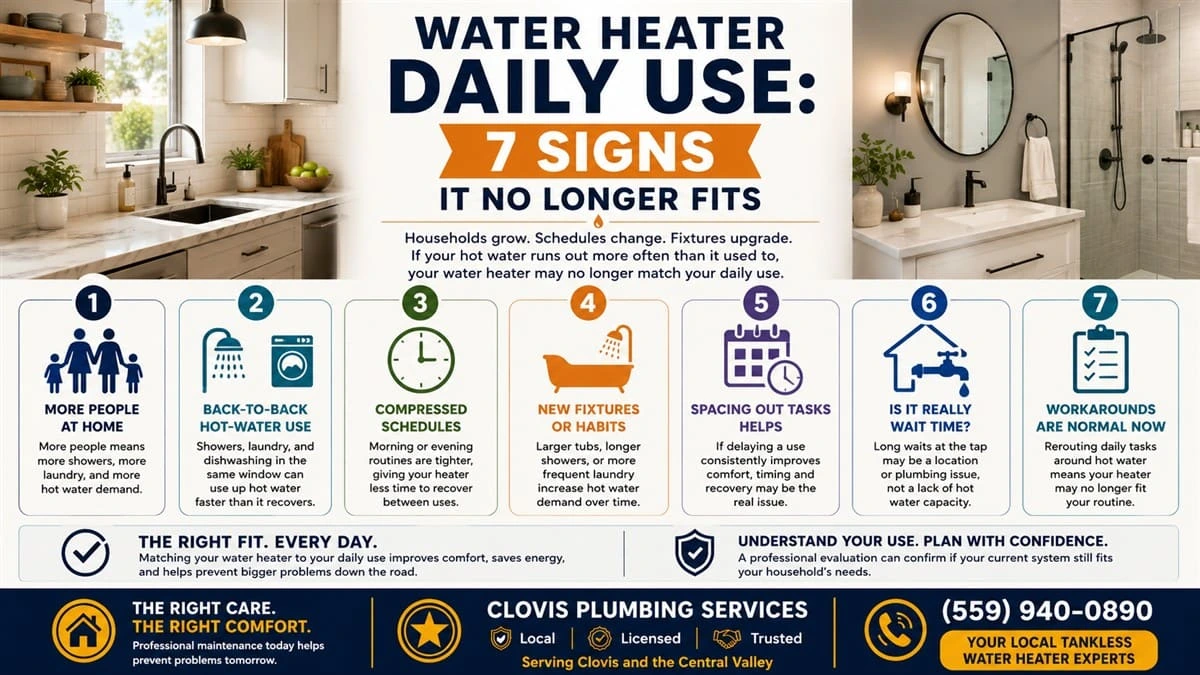
Table of Contents
What Water Heater Daily Use Really Means
Water heater daily use is not simply the total amount of hot water a household consumes over 24 hours. Timing matters because residential demand is usually concentrated into morning and evening periods, with relatively little hot-water use occurring between those peaks.
For a storage water heater, both available storage and recovery influence what homeowners experience. Hot water leaving the tank is replaced with colder incoming water, while the heating system works to restore temperature. When several uses occur close together, available hot water can decline faster than the heater can recover even though total daily consumption may not seem unusually high.
This is why two households with similar overall water consumption can have very different experiences with similar equipment. A household that spreads hot-water use throughout the day gives the system substantially more recovery time than one that concentrates several showers and appliances into the same narrow window.
1. Your Household Has More People Than Before
Household size is one of the clearest ways water heater daily use can change. Another family member, a relative staying for an extended period, children beginning to shower independently, or more people spending their days at home can increase both the frequency and duration of hot-water use.
The change may be gradual enough that no one associates it with the water heater. The equipment continues producing hot water, but the available supply is divided among more uses or consumed within shorter periods. What appears to be declining performance may therefore involve a household that simply asks more from the same system than it once did.
2. Back-to-Back Hot-Water Use Is Now Routine
Consecutive showers place a different demand on a storage water heater than the same showers separated by several hours. Adding laundry or dishwashing to that period increases the amount of hot water being withdrawn while reducing the time available for recovery.
The important question for this article is whether that pattern represents an unusual event or ordinary life. If shortages happen primarily during exceptional periods, our guide to water heater problems during high demand examines what unusually heavy use can reveal. When back-to-back demand has become part of the household’s normal schedule, however, it becomes a question of daily-use fit.
3. Morning or Evening Schedules Have Become More Compressed
A household does not necessarily need more occupants to create greater peak demand. Changes in work, school, or activity schedules can cause people who previously showered at different times to begin using hot water during the same hour.
Even if total water heater daily use remains similar, compressing that demand into a shorter period changes what the system must deliver at once. The heater receives less time to recover between uses, so a routine that once felt comfortable can begin producing predictable shortages.
The same effect can occur in the evening when baths, showers, laundry, and kitchen cleanup increasingly overlap. Recognizing that timing has changed helps separate a routine-related limitation from a system that performs poorly throughout the entire day.
4. New Fixtures or Household Habits Have Changed Demand
Changes elsewhere in the home can alter hot-water demand without any modification to the water heater. A larger tub may be filled more frequently, a remodeled shower may be used longer, or a bathroom that once received little use may become part of the household’s primary routine.
Habits can change as well. More frequent laundry, different dishwasher schedules, longer showers, or additional daytime activity can gradually increase the workload placed on the system. None of these changes proves that the water heater is undersized, but they can make assumptions about the household’s previous hot-water needs less relevant.
This is why evaluating current use is more useful than simply asking whether the heater was considered adequately sized when it was installed.
5. Spacing Out Hot-Water Tasks Improves Comfort
One of the most useful observations homeowners can make is whether changing the timing of hot-water use changes the outcome. If delaying the second shower consistently prevents a shortage, or moving laundry to another part of the day eliminates a recurring problem, the relationship between demand and recovery is significant.
That does not establish that the water heater itself is in perfect condition. It does show that the household’s usage pattern influences what is happening, which helps narrow the question before repairs or replacement are considered.
A repeatable pattern is particularly useful. When the same routine produces the same result and additional recovery time consistently improves performance, water heater daily use deserves consideration as part of the evaluation.
6. The Problem Is Really Hot-Water Wait Time
Not every complaint about daily hot-water performance involves available capacity. A homeowner may have plenty of hot water once it reaches the fixture but become increasingly frustrated by how long it takes to arrive at a frequently used bathroom or sink.
That is a different issue from exhausting stored hot water. Pipe distance, fixture location, plumbing layout, and recirculation arrangements can influence delivery time even when the water heater has adequate capacity. Our guide to water heater location, comfort, and wait time explains why those factors should be separated from storage and recovery concerns.
Distinguishing between waiting for hot water to arrive and running out of hot water after it arrives prevents two different plumbing issues from being treated as though they have the same cause.
7. Workarounds Have Become Part of the Household Routine
Households are remarkably good at adapting to limitations. Someone waits before taking the next shower, laundry gets postponed, the dishwasher is not started until bathing is finished, or family members establish an informal sequence for using hot water.
Occasional scheduling can be completely reasonable, but repeated workarounds can also hide a changing relationship between household demand and system performance. When normal activities routinely have to be organized around the water heater, it is worth considering whether the equipment still provides the level of service the household expects.
Because these adaptations develop gradually, homeowners may not recognize them as evidence of changing water heater daily use until they deliberately compare today’s routine with how the home operated several years earlier.
Daily-Use Mismatch Does Not Automatically Mean Replacement
Determining that household use and water-heater performance are no longer perfectly aligned does not establish what should be done about it. Equipment condition, age, recovery, maintenance history, severity of the inconvenience, and the household’s expectations all contribute to that decision.
Age and fit should also be considered separately. An older water heater can still match a modest household’s routine, while relatively new equipment can feel inadequate if the household’s needs have changed substantially. The fact that a heater is old does not by itself establish a daily-use mismatch, just as a mismatch does not prove the heater has reached the end of its useful service.
When age, repeated repairs, and changing performance become part of the same decision, our guide to when water heater repairs stop making sense addresses the repair-versus-replacement question in greater detail.
Observe Water Heater Daily Use Before Drawing Conclusions
Homeowners do not need to calculate exact gallons of hot-water consumption to identify useful patterns. Start by noting when a shortage occurs, which fixtures or appliances are operating, whether another major hot-water use immediately preceded it, and whether allowing additional recovery time changes the result.
It can also help to compare several ordinary days rather than focusing on one unusually busy event. A shortage that repeatedly appears during the same normal morning routine provides more useful evidence of a daily-use mismatch than an isolated problem during a house full of guests.
These observations can make a professional evaluation more productive because they explain what the water heater is being asked to do when the problem occurs. That context helps distinguish routine demand from equipment deterioration or another plumbing condition.
When Water Heater Daily Use Becomes a Planning Issue
If normal household routines have clearly changed and the existing system repeatedly struggles to meet them, daily use becomes relevant to future water-heater planning. That does not mean the answer is automatically a larger tank. Storage, recovery, equipment condition, household demand, available fuel or electrical service, location, and existing installation conditions can all influence the appropriate approach.
The purpose of this article is not to duplicate those installation decisions. If replacement becomes appropriate, our Water Heater Installation service hub explains the broader equipment, installation, and replacement considerations for Clovis homes.
Keeping those subjects separate allows this supporting article to answer its narrower question: does the existing water heater still fit the way the household normally uses hot water?
When Professional Evaluation Makes Sense
Professional evaluation becomes useful when ordinary daily routines repeatedly produce shortages, household or fixture changes have significantly altered demand, or the pattern cannot be clearly separated from declining water-heater performance. The objective is to identify what is actually limiting comfort before deciding whether any equipment change is appropriate.
You can view Clovis Plumbing Services on Google to see local reviews and information about our plumbing services in Clovis.
FAQs: Water Heater Daily Use
What does water heater daily use mean?
Water heater daily use describes how a household uses hot water throughout a normal day, including the amount, timing, duration, and overlap of showers, appliances, and other fixtures. These patterns help determine whether available storage and recovery still match the household’s routine.
How can I tell if my water heater still fits my daily use?
Look for repeatable patterns during normal household activity. If hot water consistently runs short during the same showers, appliances, or morning and evening periods but performs better when those activities are spaced apart, household demand and recovery may no longer be well matched.
Can water heater daily use change without adding more people?
Yes. Work and school schedules, longer showers, remodeled bathrooms, new fixtures, appliance routines, and changes in when household tasks occur can alter water heater daily use even when the number of people in the home stays the same.
Does a daily-use mismatch mean I need a new water heater?
Not necessarily. A mismatch identifies a relationship between household demand and available hot water, not the appropriate solution. Equipment condition, recovery, household expectations, installation conditions, and the severity of the problem should be considered before deciding whether replacement makes sense.
When should water heater daily use be professionally evaluated?
Professional evaluation makes sense when ordinary household routines repeatedly cause shortages, household or fixture use has changed significantly, or you cannot determine whether the problem comes from demand, recovery, equipment condition, or another part of the plumbing system.