Two homes can use similar tankless water heaters and still require very different installations. Tankless installation scope depends on more than removing a conventional storage water heater and mounting a smaller unit in its place. Tankless equipment may have different requirements for fuel supply, electrical power, venting, plumbing, drainage, and installation location. Household hot-water demand also affects equipment sizing and how the complete system should be planned.
Some homes already have infrastructure that works well with the proposed tankless system, making the conversion relatively straightforward. Others can support tankless but may need gas-piping changes, electrical work, new venting, condensate drainage, plumbing modifications, or a different equipment location. Even when the new unit is installed near the existing water heater, the connections and supporting infrastructure may need to be evaluated or modified to meet the requirements of the selected equipment.
These differences are why tankless installation scope can vary considerably from one property to another. The age of the home alone does not determine how involved the project will be; the existing utilities, mechanical layout, available installation space, and expected hot-water demand are often more important. Evaluating these conditions before selecting equipment gives homeowners a clearer picture of what the conversion may require and whether the proposed system is a practical match for the home.
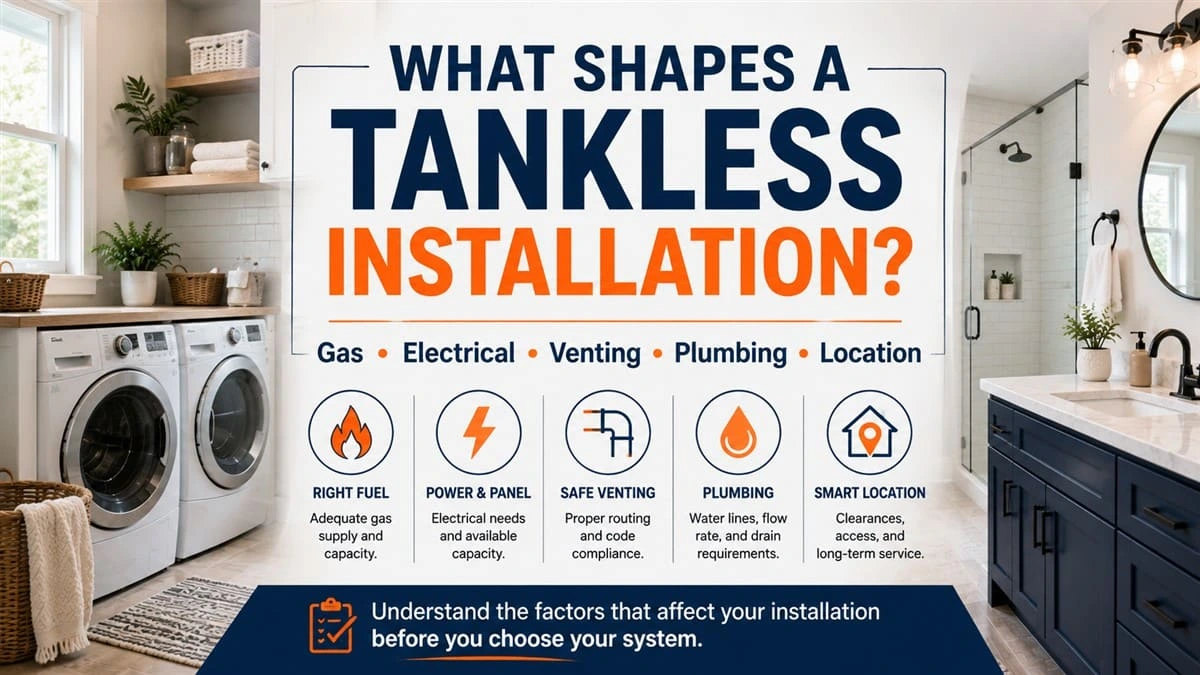
Table of Contents
Why “tankless installation cost” rarely has one simple answer
Tankless installation cost is closely connected to the amount of work required to integrate the equipment with the home. A conventional tank-to-tank replacement can often reuse portions of the existing plumbing, fuel supply, electrical connection, and venting. A tank-to-tankless conversion may have different requirements, particularly when the new equipment needs greater gas capacity, a different venting system, condensate drainage, electrical modifications, or a new installation location.
This means two homeowners purchasing similarly priced equipment can end up with substantially different project costs. One home may already have suitable utilities and an accessible location, while another requires gas-piping changes, new venting, electrical work, drainage, or modifications to existing water piping. The difference comes from the tankless installation scope, not simply the price of the water heater.
The better way to understand installation cost is therefore to determine what the individual home actually requires. The complete tankless water heater installation process involves evaluating the equipment and the home’s supporting infrastructure together rather than treating the heater as an isolated appliance.
What Changes the Tankless Installation Scope?
Several conditions can change tankless installation scope, and they often work together. Fuel type, available utility capacity, venting, equipment location, plumbing, drainage, electrical connections, and household hot-water demand can all affect what must be done before the system is ready for operation.
Understanding these components individually makes it easier to see why one installation may require relatively modest changes while another involves more extensive modifications.
Whether your home’s fuel source matches the unit
The first major consideration is the energy source. Gas-fired and electric tankless water heaters have very different infrastructure requirements, and choosing between them involves more than comparing equipment efficiency or purchase price.
A gas-fired tankless water heater must have an adequate fuel supply for the equipment and the home’s other gas appliances. Existing gas piping should not be assumed adequate simply because a gas storage water heater is already installed. Available supply, pipe sizing and configuration, equipment requirements, and other connected gas loads all need to be considered.
Whole-home electric tankless systems present a different challenge because of their electrical demand. Depending on the equipment, available service capacity, panel capacity, breaker space, circuits, and wiring may need to be evaluated. Our guide to gas vs electric tankless water heaters explains how these differences can affect equipment selection and home requirements.
Venting and exhaust routing in real-world layouts
Gas-fired tankless water heaters must discharge combustion gases using a venting system appropriate for the particular equipment and installation. Existing storage-water-heater venting should not automatically be assumed compatible because tankless equipment may have different requirements for vent materials, configuration, termination, and manufacturer-specified clearances.
The proposed vent route can have a significant effect on tankless installation scope. An accessible location with a practical route to an approved termination may require less modification than a location where the vent must travel farther, navigate structural obstacles, or require new wall or roof penetrations.
Condensing tankless equipment introduces another consideration because the condensate produced during operation must be managed appropriately. The location of the unit and availability of a suitable drainage route can therefore influence both equipment placement and the amount of installation work required.
Water line sizing and flow expectations
Tankless water heaters produce hot water differently from storage tanks, but the home’s existing water piping remains an important part of overall system performance. Pipe condition, water pressure, plumbing layout, fixture demand, and the distance hot water must travel can all affect what homeowners experience after installation.
The tankless unit itself must also be sized for the home’s expected simultaneous demand. A household using a shower, washing machine, and other hot-water fixtures at the same time creates a different requirement than a household where hot-water use rarely overlaps. The system needs sufficient heating capacity at the required temperature rise to support the expected flow.
Understanding how tankless water heaters work helps explain why flow rate, temperature rise, and simultaneous demand are important during equipment selection. Installation planning and equipment sizing should work together so the completed system matches the way the household actually uses hot water.
Where the unit will be placed and what the area requires
A tankless water heater can often be installed near the location of the existing storage tank, but keeping the same general location is not always the best or most practical option. The proposed location must accommodate water connections, fuel or electrical requirements, venting where applicable, drainage, manufacturer clearances, secure mounting, and access for future maintenance and service.
Relocating the equipment may solve one installation problem while creating another. Moving closer to an exterior wall might simplify venting, for example, but could require additional water or gas piping. An exterior installation may address certain indoor vent-routing limitations when equipment designed for outdoor installation is used, but utility routing, mounting, clearances, and exposure still need to be considered.
Equipment location can therefore have a substantial effect on tankless installation scope and should be evaluated as part of the complete system rather than selected solely because a particular wall has available space.
Electrical needs for ignition, controls, and reliability
Gas-fired tankless water heaters generally require electrical power for ignition, controls, sensors, and other internal components. The installation therefore needs an electrical connection that meets the requirements of the selected equipment.
In some homes, an appropriate power source is already available near the proposed location. In others, electrical work may be necessary to provide the required connection. That work becomes part of the installation even though the water heater primarily uses gas to produce heat.
Electric tankless systems involve a much larger electrical evaluation because electricity is the heating source itself. This distinction is important when comparing gas and electric equipment: both can require electrical infrastructure, but the amount of electrical capacity needed can be dramatically different.
Permit requirements and inspection readiness
Tankless installation may involve permit and inspection requirements depending on the jurisdiction and the work being performed. Those requirements can influence how gas piping, electrical connections, venting, drainage, equipment mounting, clearances, and other components are installed.
A conversion should therefore be planned around the complete installation rather than simply getting the heater operational. Work that changes gas piping, electrical infrastructure, venting, or other building systems may introduce requirements that would not necessarily be encountered in an otherwise straightforward tank-to-tank replacement.
Local requirements and the manufacturer’s installation instructions should be considered during planning so necessary components are incorporated into the tankless installation scope rather than discovered after equipment has already been selected.
How to compare quotes without getting trapped by a single number
Comparing tankless estimates is more useful when homeowners compare scope rather than price alone. Two estimates that appear to describe the same installation may contain very different assumptions about gas piping, venting, electrical work, drainage, equipment location, permits, start-up, and other components.
A lower estimate is not automatically incomplete, and a higher estimate is not automatically more thorough. The important question is whether each estimate addresses the actual conditions of the home and clearly identifies the work included in the proposed installation.
Look for what the quote assumes about existing systems
Existing infrastructure can dramatically affect the proposed scope. If an estimate assumes the current gas piping, electrical connection, vent route, or water connections can be reused, that assumption should be appropriate for the selected equipment and actual site conditions.
Homeowners should be able to understand which components are remaining, which are being modified, and which are being replaced. That information provides considerably more insight than comparing total prices without knowing what each contractor has included.
A clearly defined tankless installation scope also reduces the likelihood that important infrastructure requirements will appear unexpectedly after the project begins.
Separate equipment choice from home readiness
Selecting a tankless model and determining whether a home is ready for that equipment are related but separate decisions. A particular unit may have the heating capacity a household needs while still requiring substantial modifications to the home’s utilities or installation location.
Conversely, a home may have favorable infrastructure but still need different equipment because of peak hot-water demand. Equipment selection should therefore follow an evaluation of both household demand and the home’s ability to support the system.
Our guide to signs your home is ready for tankless explains the conditions that can make a conversion relatively straightforward and those that may require additional planning.
Pay attention to performance-related items
Installation planning is not limited to getting water, fuel, and power connected to the heater. The completed system should also be configured around expected hot-water demand, equipment requirements, and the home’s plumbing arrangement.
Equipment sizing affects whether the system can maintain the desired temperature during simultaneous use, while plumbing layout affects how long heated water takes to reach distant fixtures. Existing recirculation systems, when present, may also influence equipment selection and installation planning.
These considerations help determine whether the proposed installation will perform as the homeowner expects after the work is complete. They should therefore be considered during planning rather than treated as unrelated issues after installation.
Clarify what “installation” includes for your installer
The word “installation” can describe different scopes of work. One proposal may refer primarily to setting and connecting the equipment, while another may include necessary utility modifications, venting, drainage, permits, start-up procedures, testing, and removal of the existing water heater.
A useful comparison requires understanding what each proposal actually includes. Homeowners should also know whether additional work has been identified as necessary, optional, excluded, or dependent on conditions discovered during installation.
A detailed scope makes it easier to compare proposals fairly and understand the actual installed cost rather than focusing only on the price of the water heater.
Where homeowners often misunderstand tankless installation pricing
Tankless conversions can be difficult to estimate from generic online pricing because the heater is only one component of the completed system. The condition of the home and the amount of infrastructure work required can have as much influence on the project as the equipment itself.
This is especially important when comparing a tankless conversion with another conventional tank replacement. The two options may involve substantially different work even though both ultimately provide hot water to the same fixtures.
Assuming tankless is always a simple replacement
A tankless water heater is physically smaller than a conventional storage tank, but smaller equipment does not necessarily mean a simpler installation. The new system may have different requirements for fuel supply, venting, electricity, drainage, mounting, and equipment clearances.
Some homes can accommodate those requirements with relatively modest changes. Others need more extensive modifications before the system can be installed properly. The resulting tankless installation scope is determined by those existing conditions rather than simply by the size of the new heater.
Treating every conversion as a straightforward heater swap can therefore create unrealistic expectations about both installation requirements and project cost.
Believing the unit price tells you the installed price
The retail price of a tankless water heater does not represent the complete cost of converting a home. Equipment price does not account for the labor and materials that may be necessary to integrate the heater with the existing building systems.
Gas-piping modifications, vent components, electrical work, water connections, condensate drainage, mounting, permits, and relocation work can all become part of the project depending on the installation. Some homes require relatively little additional work, while others require substantially more.
For homeowners evaluating whether the larger investment makes sense, our guide to are tankless water heaters worth it in California examines installed cost alongside hot-water demand, energy use, maintenance, and long-term ownership.
Confusing “cheaper quote” with “better deal”
Price matters, but it only becomes meaningful when the proposed scopes are comparable. A lower estimate that includes everything required for the installation may represent excellent value, while another low estimate may simply be based on different assumptions about what can be reused or what work is included.
The same caution applies to a higher estimate. A larger number does not prove that the proposal is more complete or that the installation will be better. What matters is whether the proposed work is appropriate for the home, selected equipment, and applicable requirements.
Comparing the actual components of each tankless installation scope provides a better basis for evaluating value than ranking estimates by total price alone.
Expecting the same answer from every professional
Different contractors may propose different approaches to the same home because there can be more than one practical way to route venting, locate equipment, modify utilities, or address existing conditions. Differences between proposals do not automatically mean one contractor is wrong.
What homeowners should expect is a clear explanation of why the proposed work is necessary and how it relates to the selected equipment and conditions of the home. When two scopes differ substantially, understanding those underlying assumptions can clarify why the estimates are different.
The goal is not necessarily to make every proposal identical. It is to understand enough about the proposed installation to compare the options intelligently.
What to consider next before you commit to an installation
Before committing to a tankless conversion, homeowners should understand both what they expect from the new system and what the home will require to support it. Those two considerations should be evaluated together because they influence equipment selection and tankless installation scope.
A system selected solely on advertised capacity or equipment features may not be the best fit if household demand or infrastructure requirements have not been considered. Likewise, choosing the easiest installation does not necessarily produce the best result if the equipment does not match how the household uses hot water.
Decide what “success” looks like in your home
Homeowners convert to tankless for different reasons. Some regularly run out of stored hot water, while others want to recover space, reduce standby heat loss, replace aging equipment, or incorporate a new water-heating system into a larger remodel.
Those priorities can influence both equipment selection and installation scope. A household with substantial simultaneous demand may need different capacity than a smaller household with staggered hot-water use. A homeowner concerned about wait time at distant fixtures may need to consider plumbing layout or recirculation separately from the decision to install tankless.
Defining the desired outcome before selecting equipment makes it easier to evaluate whether the proposed system and installation plan actually address the homeowner’s goals.
Plan for the home’s age and layout in Clovis
Clovis homes vary in age, construction, utility configuration, and mechanical layout. Some properties may already have infrastructure that accommodates a tankless conversion relatively easily, while others may have existing gas, electrical, venting, plumbing, or space conditions that require additional work.
Age alone does not determine whether a home is suitable for tankless. A newer property can still have limitations for a particular system, while an older home may accommodate tankless effectively after appropriate modifications.
The important step is evaluating the actual conditions rather than assuming readiness based on the age or appearance of the home. That allows the tankless installation scope to be built around the property instead of trying to apply the same conversion plan to every house.
Use a professional confirmation to reduce guesswork
Online information can help homeowners understand the factors that affect tankless installation, but the final scope depends on conditions at the property. Fuel supply, electrical capacity, venting options, drainage, equipment location, water piping, and household demand all need to be considered in relation to the selected system.
A site evaluation can identify which existing components are suitable for reuse and which modifications are actually necessary. That provides a more reliable basis for selecting equipment, establishing the installation scope, and understanding the complete project cost.
For local context, you can view Clovis Plumbing Services on Google to see homeowner reviews and experience with plumbing and water-heating work in the Clovis area.
FAQs about tankless installation scope
What changes tankless install scope the most?
Tankless installation scope is often affected most by the home’s fuel or electrical capacity, venting requirements, equipment location, and the modifications needed to connect the new system. Plumbing, condensate drainage, household hot-water demand, and existing infrastructure can also influence how much work a conversion requires.
Why do two tankless quotes look so different?
Tankless quotes can differ because contractors may propose different equipment, installation locations, vent routes, utility modifications, or assumptions about existing components that can be reused. Comparing what each proposal actually includes provides a better basis for evaluating the estimates than comparing total price alone.
Can older homes in Clovis still switch to tankless?
Yes. The age of a home does not by itself determine whether tankless is practical. Older homes may require additional evaluation or modifications to gas piping, electrical capacity, venting, plumbing, drainage, or the installation location before the selected equipment can be properly installed.
Does installation quality affect long-term operating cost?
It can. Equipment sizing, fuel supply, venting, system settings, plumbing configuration, and maintenance can all affect tankless performance and energy use. A properly planned installation helps the equipment operate according to its requirements and reduces the likelihood that installation-related problems will affect performance.