A garbage disposal works in a demanding environment where food residue, water, and repeated mechanical operation are part of everyday use. Although the appliance is designed for those conditions, the way it is used can influence cleanliness, reliability, and the amount of unnecessary stress placed on its internal components.
Good maintenance does not require treating the disposal like a machine that needs frequent disassembly or complicated homeowner servicing. In most kitchens, the more useful approach is consistent operation: process appropriate food residue in reasonable amounts, use adequate water, keep problematic materials out of the unit, and keep the sink opening and accessible surfaces clean.
Maintenance also has limits. Routine care cannot reverse mechanical wear, corrosion, damaged seals, motor problems, or other component failures. Recognizing that distinction helps homeowners avoid treating every operational problem as something that additional cleaning or different usage habits will correct.
If an existing disposal eventually reaches the point where replacement is more appropriate than continued service, our garbage disposal installation service covers the compatibility, connections, installation conditions, and professional replacement work involved in installing another unit.
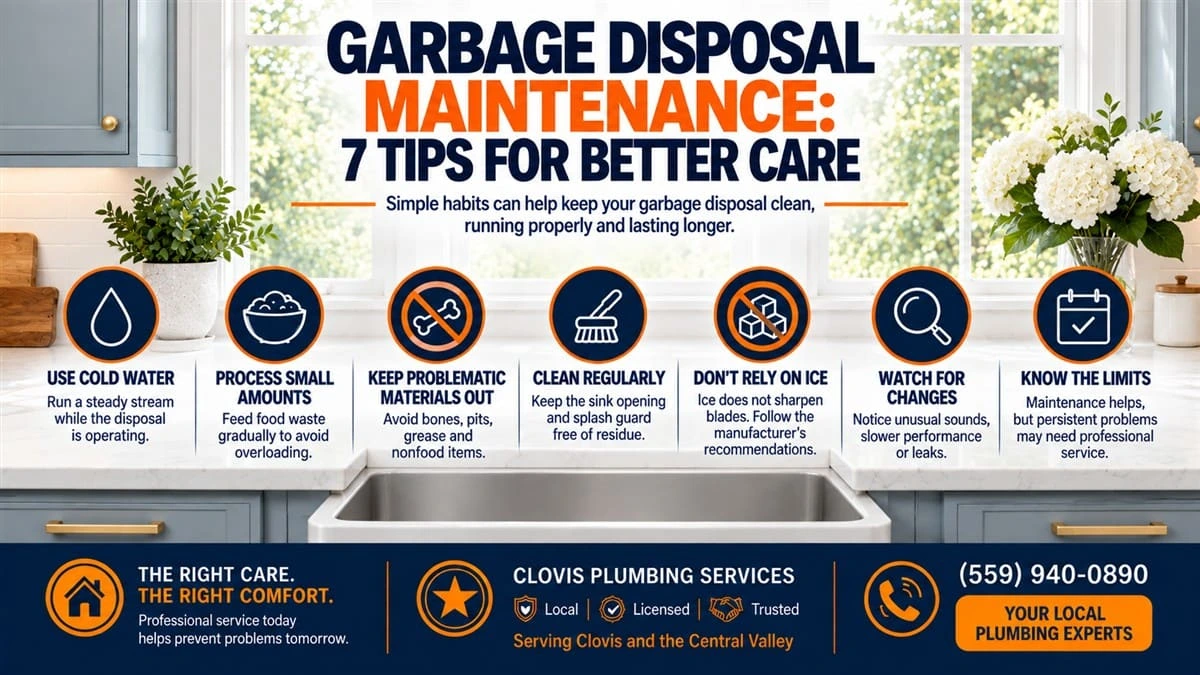
Table of Contents
1. Use Cold Water While the Disposal Is Operating
Running an adequate stream of cold water while using the garbage disposal helps move processed food residue through the grinding chamber and into the drain piping. Water is part of normal disposal operation, so using the appliance without sufficient flow can make it more difficult for material to move away from the unit.
Cold water is generally preferable during disposal operation because fats and grease should not be intentionally introduced into the drain system in the first place. Hot water does not make grease disposal-safe, and pouring cooking fats, oils, or grease into the sink can contribute to buildup farther downstream as those materials cool.
Allowing the water to continue briefly after the food residue has cleared can also help carry remaining particles beyond the immediate disposal and sink connection. There is no need to treat this as a complicated timed procedure; the objective is simply to provide sufficient water while material is being processed and flushed away.
2. Process Food Residue in Manageable Amounts
A garbage disposal is better suited to handling ordinary food residue in moderate amounts than receiving a large quantity of waste all at once. Gradually feeding appropriate material gives the grinding mechanism and water flow an opportunity to process and move it through the system without unnecessary loading.
Large quantities can increase resistance inside the unit and make jams or interruptions more likely, particularly when the material is dense or difficult to process. The disposal should not be treated as a substitute for the trash or compost container simply because food waste will physically fit through the sink opening.
Changes in operating sound can provide useful feedback. If a disposal begins laboring, slowing, or sounding substantially different during ordinary use, repeatedly adding more material is unlikely to improve the situation.
3. Keep Problematic Materials Out of the Disposal
What goes into the disposal is one of the most important aspects of routine care. Hard objects and nonfood materials such as utensils, glass, metal, and other foreign objects can interfere with the grinding mechanism and should never intentionally enter the unit.
Certain food waste also deserves caution. Large bones, fruit pits, fibrous material, and excessive quantities of difficult food scraps can create more resistance than ordinary residue. Fats, oils, and grease should be kept out of the drain because they can accumulate within the plumbing system rather than simply disappearing after passing through the disposal.
Coffee grounds and other fine particulate material can also accumulate when combined with other drain residue. The practical rule is straightforward: a garbage disposal can handle appropriate food residue, but it is not designed to accept everything generated during food preparation and cleanup.
4. Keep the Sink Opening and Accessible Areas Clean
Food residue can collect around the sink flange, splash guard, and other accessible surfaces near the disposal opening. Cleaning these areas as part of normal kitchen care can help reduce residue and odors without requiring homeowners to reach into or disassemble the appliance.
The removable or accessible portions of the splash guard can accumulate material on surfaces that are not immediately visible from above. Cleaning should follow the disposal manufacturer’s instructions, and the appliance should not be energized while someone is cleaning near the opening.
Strong chemical drain cleaners should not be treated as routine garbage disposal maintenance. Product compatibility varies, and chemical cleaners may introduce unnecessary risks to the appliance, plumbing components, or anyone who later works on the drain system.
5. Do Not Rely on Ice to “Sharpen the Blades”
One of the most persistent garbage disposal maintenance myths is that ice cubes sharpen the appliance’s blades. Most residential garbage disposals do not operate like blenders or food processors with conventional cutting blades that require sharpening. Instead, rotating components help force food material against a stationary grinding ring.
Ice may be used with some disposals as part of a manufacturer’s recommended cleaning procedure, but that is different from claiming that ice sharpens blades. Maintenance advice should follow the instructions for the particular disposal rather than assuming that a household trick applies universally.
The distinction matters because good maintenance should be based on how the appliance actually operates. Routine care is more effectively focused on appropriate food waste, adequate water, reasonable loading, cleanliness, and awareness of changes in performance.
6. Pay Attention to Changes in Sound and Operation
Routine maintenance provides an opportunity to notice changes before they become easy to ignore. Unusual vibration, new operating sounds, slower performance, repeated interruptions, or a disposal that suddenly behaves differently can indicate that routine care is no longer the only consideration.
Not every change means the disposal has failed. A temporary loading condition or another correctable issue may sometimes be involved. Recurring symptoms, however, should not simply be considered part of normal maintenance, especially when the appliance previously operated consistently.
A disposal that receives power and hums without operating normally is a good example of a symptom that deserves separate evaluation rather than additional cleaning. Our garbage disposal humming guide explains six common reasons that symptom can occur and the other operating conditions that can help put it into context.
7. Know When Maintenance Has Reached Its Limit
Maintenance can support normal operation, but it cannot restore components that are mechanically worn, damaged, leaking, or failing. Once problems become persistent, repeatedly cleaning the disposal or changing usage habits may no longer address the underlying condition.
Age, leakage, corrosion, recurring jams, electrical symptoms, and changes in operating performance can all help distinguish routine care from a problem requiring further attention. This boundary is important because maintenance should not turn into repeated attempts to disassemble, manipulate, or repair a malfunctioning electrical appliance.
When an existing unit is leaking, repeatedly jamming, failing to operate, or exhibiting another persistent malfunction, our garbage disposal repair service addresses professional diagnosis and repair separately.
Can Garbage Disposal Maintenance Extend Its Lifespan?
Proper use and routine care can help reduce avoidable stress, residue, and misuse, but no maintenance routine can establish exactly how long a garbage disposal will last. Construction, frequency of use, household demand, mechanical wear, corrosion, and previous problems also influence longevity.
For that reason, maintenance should be viewed as one part of ownership rather than a guarantee against eventual failure. Two disposals receiving similar care can still have different service lives because their usage histories and mechanical condition are not identical.
Homeowners evaluating an older unit can review our garbage disposal lifespan guide for a closer look at how usage, maintenance history, construction, mechanical wear, recurring problems, age, and overall condition can affect longevity.
Maintenance, Repair, and Replacement Are Different Decisions
Routine maintenance is intended to support an operating disposal through appropriate use and care. Repair becomes relevant when a particular malfunction needs to be diagnosed or corrected, while replacement becomes a separate consideration when age, condition, recurring failures, or the nature of the problem makes continued service less practical.
Those decisions should not be collapsed into a single rule. An older disposal does not automatically need replacement, and a newer disposal is not automatically worth repairing regardless of the problem. The condition of the appliance and the nature of the failure provide more useful information than age alone.
When replacement does enter the discussion, project conditions can affect more than the price of the disposal itself. Our garbage disposal cost guide explains how the unit, existing installation, sink and mounting compatibility, drain alignment, electrical configuration, dishwasher connections, and additional work can influence the overall project cost.
Garbage Disposal Maintenance in Clovis Homes
Everyday disposal care is relatively straightforward when homeowners focus on appropriate use rather than maintenance myths or unnecessary mechanical work. Adequate cold water, manageable food residue, sensible cleaning, and attention to changing symptoms provide a practical foundation for caring for the appliance.
When routine maintenance gives way to recurring mechanical problems, leaks, or other signs of failure, the condition of the disposal should be evaluated rather than repeatedly treated as a cleaning issue. Homeowners can also view customer feedback and examples of our local plumbing work on the Clovis Plumbing Services Google Business Profile.
FAQs: Garbage Disposal Maintenance
How often should I clean my garbage disposal?
There is no single cleaning schedule that applies to every garbage disposal because usage varies from one household to another. Accessible areas should be cleaned when residue or odors develop and as part of normal kitchen cleaning, while any additional cleaning procedure should follow the manufacturer’s instructions for the particular unit.
Should I use hot or cold water with a garbage disposal?
Cold water is generally appropriate while a garbage disposal is operating because it helps carry processed food residue through the unit and drain piping. Fats, oils, and grease should not intentionally be poured into the disposal regardless of water temperature because they can contribute to buildup within the plumbing system.
Do ice cubes sharpen garbage disposal blades?
No. Most residential garbage disposals do not use conventional cutting blades that need sharpening like a blender or food processor. Some manufacturers may recommend ice as part of a cleaning procedure, but that should not be confused with sharpening blades, and care instructions should follow the recommendations for the specific disposal.
What should I avoid putting in a garbage disposal?
Foreign objects such as glass, metal, and utensils should never intentionally enter a garbage disposal. Large bones, fruit pits, excessive fibrous material, fats, oils, grease, and large quantities of food waste can also create problems, so the disposal is best used for appropriate food residue in manageable amounts.
When is garbage disposal maintenance no longer enough?
Maintenance is no longer the appropriate response when a disposal has persistent leaks, repeated jams, electrical symptoms, recurring humming, significant mechanical problems, or other failures that routine cleaning and proper use cannot address. At that point, the condition should be evaluated to determine whether professional repair or replacement is appropriate.